|
An
earthquake surprised the habitants of Dhaka, Bangladesh on
25 August, measuring 3.0 on the Richter scale. People in
there fear another quake which maybe will be stronger than
this and they think preparedness is not their consolation. The
tremor’s epicentre was around 40km from Bangladesh’s
second city, Chittagong, but resulted in no casualties. It
comes less than a month after a 5.6 degree quake rocked the
capital, Dhaka, and other parts of the impoverished nation
on 26 July. On 20 March two mild tremors were felt in Dhaka
and three other northeastern districts. On 7 November 2007,
a 6.0 degree quake shook the southeastern region. Its centre
was at Roninpara, about 70km from Chittagong, cracking open
a fault in the hills of Chittagong and Khagrachhari
districts. Due to its geographic location Bangladesh is
considered high risk for earthquakes, according to experts.
A roundtable on 31 March 2008
organized by the Network for Information Response and
Preparedness Activities on Disaster (NIRAPAD),
a national non-governmental organization (NGO) - in
association with the US Agency for International Development
(USAID) and CARE Bangladesh - concluded that the loss of
lives and property could be reduced significantly if the
government took proper preparedness and mitigation measures.
“Unplanned urbanization,
overpopulation, poorly constructed structures, lack of
coordination between institutions concerned, inadequacy of
recovery tools and lack of awareness among the people place
the country at high risk,” said Maksud Kamal, an expert on
earthquake and tsunami preparedness at the Comprehensive
Disaster Management Programme (CDMP)
within the Ministry of Food and Disaster Management.
Experts
cite a clear lack of direction in the government’s
earthquake preparedness efforts.
A study by
the Bangladesh
Earthquake Society
warned that a major earthquake could destroy 28 percent of
buildings and structures in Dhaka alone.
“A
relatively long period of `rest’ from any major seismic
activity, and high attention paid to other disasters such as
cyclones and floods, have led to a neglect of disaster
preparedness for earthquakes - the most destructive of all
natural disasters,” said a statement by the society on 4
August. Sirajul Islam, chief urban planner of Dhaka City
Corporation (DCC), said the national building construction
code of 1993 was updated in 2006, but no ministry or
department had been assigned to implement it. Abul Kalam of Bangladesh
University of Engineering and Technology alleged building
codes were often not adhered to: “Most of the buildings in
major cities are built without following the building
codes,” he said. He also said the Public Works Department
(PWD) had stopped working on earthquake preparedness, and
called on the government to turn the PWD into an institution
with the authority to demolish and reconstruct buildings.
|
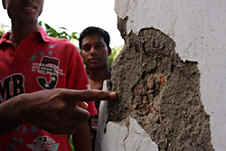
This
left the last earthquake. People fear this situation
to get worse.
|
|