【Event Report】 Natural Disaster Youth Summit 2025 in KOBE
(Hybrid Event: March 22, 2025)
Youth representatives from five countries and regions around the world
delivered powerful presentations under the theme “Facing Climate Change:
Becoming Creators of a Sustainable Society.” Natural disasters caused by
climate change—such as floods, wildfires, volcanic eruptions, and cyclones—are
diversifying, confronting us with unprecedented disasters. Overseas regional
disaster prevention initiatives to become creators of a sustainable society
had evolved far beyond imagination. “2025 in KOBE” became a forum for discussing
global disaster prevention learning. Each participant from around the world
heightened both their personal disaster awareness and their awareness of
international disaster prevention, making it a fruitful conference.
Program
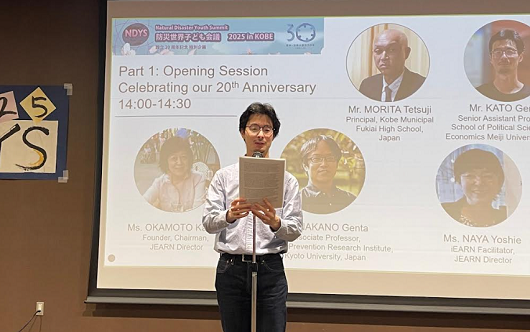
Part 1: Celebrating Our 20th Anniversary
14:00-14:25
As we mark our 20th anniversary, we take a new step forward toward our vision of “Youth Connecting the Future of Disaster Prevention.”
Greetings: Kazuko Okamoto (Founder of NDYS,
Executive Committee Chairperson for 2025inKOBE)
Greetings: Kato Genjin (Full-time Lecturer, Faculty of
Political Science and Economics, Meiji University; NDYS-OB)
Greetings: Tetsuji Morita (Principal, Kobe Municipal
Fukiai High School))
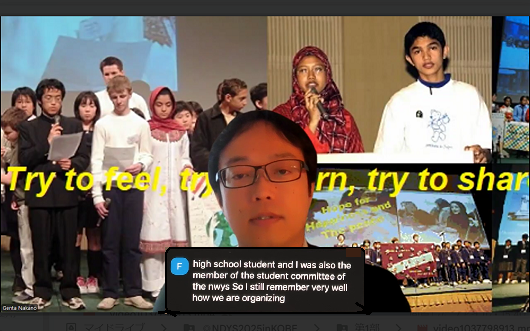
Congratulatory Video Message: Genta Nakano (Associate
Professor, Center for Research on Mega-Disasters, Disaster Prevention Research Institute, Kyoto University; NDYS-OB)
Introducing the Congratulatory Video Message: Yoshie Naya (iEARN Facilitator,
JEARN Board Member)
NDYS 20th Anniversary Message from iEARN-NDYS OBOGs Worldwide
Part 2: Activity Presentations & Discussion
14:30-16:50
1. Let's pass on the experiences and lessons of the Great Hanshin-Awaji
Earthquake to the next generation, both in Japan and around the world!
◇From the Great Hanshin-Awaji Earthquake 30 years.
Proposals from high school students
Kobe Municipal Fukiai High School International Studies Department,
Grade 2 Global Studies Disaster Prevention Team
This year marks the 30th anniversary of the Great Hanshin-Awaji Earthquake. We must never forget the events that occurred during this disaster, which laid the foundation for the development of international disaster prevention education. We must apply the lessons learned to improve Japan's disaster response capabilities and prepare for the Nankai Trough earthquake as part of regional disaster prevention efforts.
Six members of the Disaster Prevention Team from the Global Studies program in the International Studies Department, Class of 2023, at Kobe Municipal Fukiai High School analyzed this issue, focusing on three key areas: health, human rights, and education. As our proposal, we present “LPD: The Disaster Prevention Project.”
Student PowerPoint presentations:
① Health (Toilet Issues)
② Health (Dietary Conditions in Evacuation Centers)
③ Human Rights (Understanding and Support for Foreigners,
the Elderly, and People with Disabilities in Evacuation Centers)
④ Education (Self-Help and Mutual Aid During the
Golden 72 Hours)
⑤ Education (Reducing Disaster-Related Deaths)
⑥ Education (The Evolution and Challenges of Disaster
Prevention Education)
Our Recommendations:
Our proposed “LPD: Disaster Preparedness Project” aims to enable high school
students and local residents not only to learn about past disasters but
also to acquire skills for preparing for future disasters. This project
progresses through three stages: “Learn: Study,” “Practice: Prepare,” and
“Demonstrate: Implement.”
◇Special Lecture: 20 Years Since the Sumatra Earthquake and Indian Ocean
Tsunami
Activity Report: Applying Lessons Learned from the Great Hanshin-Awaji
Earthquake
Build Back Better: A Better Recovery for Aceh, Indonesia
Speaker: Wiser Putri Melaratuna
Reported on the Indian Ocean tsunami as a high school student from Banda
Aceh at the “NDYS2005 in Hyogo” international conference. Malik Sarre University,
NDYS Facilitator
◇Discussion with Youth Around the World
Youth Connecting the “Future of Disaster Prevention”
Themes:
1) Self-help and mutual aid measures implemented in various countries
2) What youth can do across national borders from an international disaster
prevention perspective
MC: Kobe Municipal Fukiai High School, International Studies Department,
Grade 2, Global Studies Disaster Prevention Team
1) Self-help and mutual aid measures implemented in various countries
・Elementary school students present posters at disaster prevention events
to raise awareness among local residents. (Taiwan)
・Disaster prevention education should be incorporated into the curriculum
and made mandatory. (Oman) ・Students from Kobe City's painting classes
created and published a picture book based on the story of a child born
on the day of the Great Hanshin-Awaji Earthquake. This has provided many
people with an opportunity to learn about and reflect on disasters. (Kobe)
2) What Youth Can Do Across Borders from an International Disaster Prevention
Perspective
・Japan's Proposal: Information Sharing via Hashtags Example: #YouthInAction
Hashtag Suggestions from Other Countries: #DisasterFree
・Proposals from other countries: Online disaster prevention education opportunities
(Malaysia, Oman) By quickly learning about initiatives from countries with
advanced disaster response systems and exchanging opinions, we can improve
our own national disaster prevention activities. We considered the future
of disaster prevention.
2. 30th Anniversary of the Great Hanshin Awaji Earthquake Commemorative Mini Taishogoto Concert
Music Performance as “Heart Care” Host:
Japan (Hazukko Cowboy, Yokkaichi City, Mie Prefecture)
3. Activity Presentations from Five Countries and Regions Around the World
Theme: Confronting Climate Change and Becoming Creators of a Sustainable
Society
Malaysia (SMK Sultan Abu Bakar, Kuantan, Pahang State)
Flooding occurs annually in Malaysia. This section explains The Vortex
Hydro+, a system that treats floodwater to make it suitable for drinking
and also generates electricity.
2) Disaster Prevention Education in Taiwanese Elementary Schools
This section provides a detailed introduction to disaster prevention education
conducted in Taiwanese elementary schools, including examples of disaster
drills held at schools.
3) Collaborative Learning Project in Georgia - 15 Years at NDYS Georgia
(iEARN Georgia, Tbilisi)
Georgia experiences various disasters such as floods and volcanic eruptions.
Methods to minimize damage are also discussed.
4) Impact of Cyclone Gonu
Oman (My School, High School, Muscat)
In Oman, climate change is causing cyclones to intensify, resulting in
severe damage. Action is needed to address climate change.
5) Natural Disasters in India
India (St. Mark's High School, Meera Bagh, New Delhi)
Disaster prevention through education, introduction of disaster prevention
education conducted at schools, and reporting on disaster prevention activities
for the local community.
4. Overall Impressions
I was impressed by how NDYS creates a global forum for youth to share their diverse activities and learning experiences in disaster risk reduction. Your presentations offered numerous solutions that could be applied in your respective countries and regions.
5. NDYS 2025 Declaration Announcement
We read aloud the ideas submitted by each team.
6. “SHIAWASE HAKOBERU YONI”
We sang together “SHIAWASE HAKOBERU YONI,” a song born in the wake of the
Great Hanshin-Awaji Earthquake and passed down in hopes of recovery.
7. Closing
16:50
Closing Statement: Hideaki Fujii
(Vice Executive Chairman of 2025inKOBE, Vice Chairman of FACIL)
 Language /